

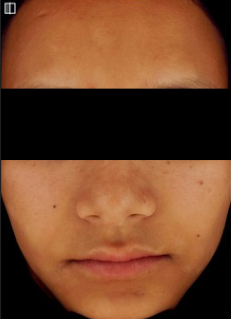
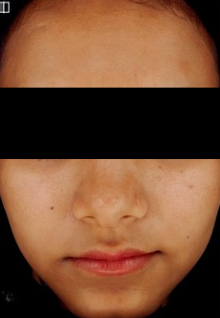
Visible treatment results with LaseMD Treatment
How LaseMD Ultra works
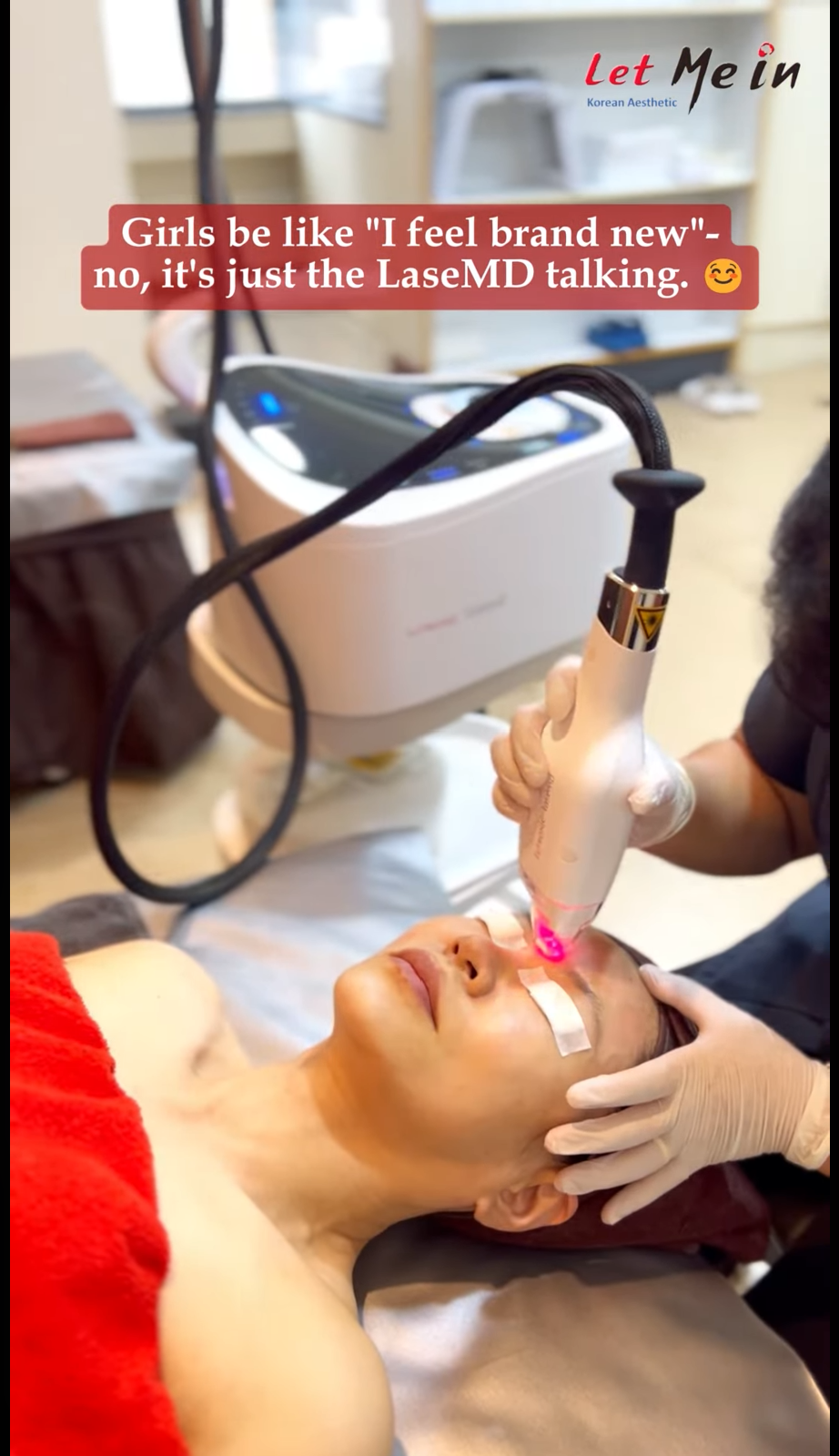
LaseMD Ultra delivers laser energy in a fractional pattern, meaning it creates thousands of tiny treatment channels rather than treating the whole surface at once. These microchannels trigger your skin's natural repair response, which boosts collagen and elastin production over the following weeks. Right after the laser pass, your provider applies a targeted ampoule while these channels are still open. This is called the Cosmeceutical Delivery System, and it allows active ingredients to absorb far deeper than regular topical use at home. Depending on your skin goal, your doctor may choose Vitamin C for brightness support, tranexamic acid for pigment control, or retinol for texture renewal. The result is a two-step treatment: controlled laser stimulation plus deep active delivery in one session.
Why LaseMD is suitable for Nepali, South Asian, and international skin tones
Nepali and South Asian skin tones often carry a higher risk of post-inflammatory hyperpigmentation when high-heat or ablative resurfacing is used, and similar caution applies across many international skin profiles. LaseMD follows a non-ablative approach, so it stimulates renewal without aggressively removing the full surface layer. This lowers irritation burden and makes it a safer long-term option for patients who want visible improvement with controlled recovery. The platform was developed in the Korean aesthetic ecosystem, where protocols are heavily optimized for Asian skin behavior. At Let Me In, our team adjusts energy, density, and ampoule selection based on skin tone, sensitivity, and pigment tendency for both Nepali and international patients.
Conditions treated with LaseMD at Let Me In
LaseMD sits within our wider skin treatments in Nepal because it is chosen by concern, not just by device name. It may be considered for shallow scars, stubborn pigmentation, and dull texture; if the goal is more hydration or repair support, your doctor may pair the plan with skin boosters instead.
- Melasma: LaseMD helps improve stubborn patchy pigmentation by supporting gradual tone correction with provider-guided settings.
- Hyperpigmentation and dark spots: The 1927nm wavelength targets excess pigment and supports a clearer look when combined with strict sun protection.
- Acne scars: By stimulating collagen remodeling, LaseMD can soften shallow scar texture and make skin look smoother over sessions.
- Fine lines and early signs of aging: LaseMD supports skin renewal and elasticity, helping reduce early creasing and tired-looking texture.
- Enlarged pores: Regular sessions help refine pore appearance by improving overall texture and collagen support around pores.
- Dull and uneven skin tone: LaseMD resurfaces gently for brighter, fresher skin tone with less downtime than aggressive resurfacing lasers.
What to expect during your LaseMD session
- Consultation at Let Me In to confirm suitability, treatment goals, and aftercare planning.
- Skin is cleansed and numbing cream is applied about 30 to 45 minutes before the laser starts.
- The LaseMD pass is performed over the treatment area and usually takes around 10 to 20 minutes.
- An active ampoule is applied immediately so ingredients can absorb through fresh microchannels.
- A cooling mask is used at the end to calm skin and support comfort before you leave.
Most patients feel warm tingling during treatment. On days 3 to 5, skin can feel slightly rough like fine sandpaper. A healthy glow is usually visible within one week.
How many sessions will you need?
Most patients notice visible improvement after one session. For stronger and longer-lasting results, a course of 3 to 5 sessions spaced 4 to 6 weeks apart is usually recommended. Maintenance sessions every 6 to 12 months are optional. Your provider will finalize the plan based on your skin concern, response pattern, and treatment goals.
Aftercare and recovery in Nepal climate
Good aftercare is a major part of good results. Right after LaseMD, your skin is more absorbent and more sensitive to UV exposure, heat, dust, and friction. In Kathmandu and Pokhara, that means sunscreen discipline is not optional.
- Use broad-spectrum sunscreen every morning and reapply when outdoors.
- Keep skin hydrated with a barrier-support moisturizer for at least 5 to 7 days.
- Avoid strong scrubs, active acids, and retinoids unless your provider allows them.
- Avoid steam, sauna, and heavy workouts in the first 72 hours.
- Expect mild dryness or rough texture for a few days, then a clearer glow by about one week.
Why choose Let Me In for LaseMD in Nepal
Your results depend on more than the machine. Protocol design, skin assessment, and follow-up quality matter just as much.
Protocol-led treatment planning
Every LaseMD treatment follows a structured skin-assessment protocol that accounts for South Asian and international skin behavior, pigment risk, and healing response.
Korean technology and Korean protocol logic
LaseMD Ultra by Lutronic is integrated with Korean-style stepwise planning, where settings, ampoules, and spacing are adjusted according to your skin goals and tolerance.
Continuity across 3 branches
You can continue your sessions at Baneshwor, Maharajgunj, or Pokhara with coordinated treatment records and a consistent plan timeline.
Patient Reviews
I came here for melasma and skin brightening treatment. I had such a wonderful experience and loved the result.
Read full review on GoogleI have done treatment for my melasma which was called Meso and I really like the results. I have also taken a Plapass B1 package and am excited for my next treatment.
Read full review on GoogleI had a wonderful facial experience. The treatment was extremely relaxing and professionally done. My skin felt deeply cleansed, hydrated, and instantly refreshed.
Read full review on Google